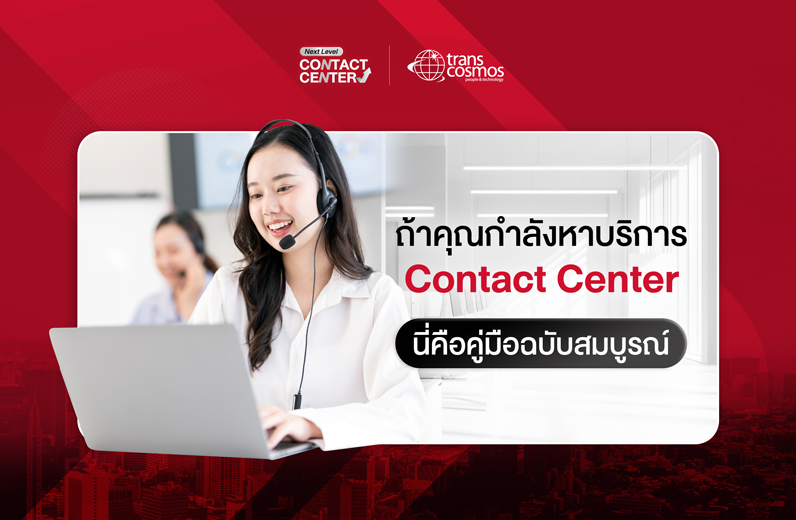
Looking for Contact Center service? Here’s Your Complete Guide.
In today’s increasingly competitive digital environment, delivering superior customer experience goes beyond products and services.
Contact Center services is now the core element in enabling businesses to connect seamlessly with customers and deliver more efficient service experiences—through inbound and outbound interactions, as well as technology that helps analyze customer data and respond to customer needs with greater accuracy.
This article provides a comprehensive overview of Contact Center services, explaining their meaning and roles beyond traditional Call Centers. It explores how Contact Centers integrate with omnichannel strategies and key technologies such as CRM, AI, Chatbots, and VOC, while offering in-depth insights into both inbound and outbound solutions, the benefits of outsourcing Contact Center services, and practical guidance on selecting the right service provider for your business needs.
When businesses effectively integrate these technologies into their customer service operations, they can deliver customer experiences that are truly differentiated and stand out from competitors. If you are looking for a partner with a deep understanding of strategy, technology, and end-to-end customer experience management, transcosmos is ready to help elevate your customer service to the next level.
Table of Contents
1. What is Contact Center?
- The Role of Contact Centers in the Digital Era
- Key Differences Between Call Centers and Contact Centers
2. The Importance of Contact Centers for Businesses
- Delivering Superior Customer Experience (CX) Through Contact Center Services
- Connecting with Omnichannel and Communication Channels Across Both Voice and Non-Voice Channels
- Collecting and Analyzing Customer Data for the Strategic Development
3. Technologies That Elevate Contact Center Performance
- CRM System (Customer Relationship Management)
- AI & Chatbot
- Data Analysis & Big Data Analytics
- VOC (Voice of Customer)
4. Inbound Call Solution
- Types of Inbound Solutions
- Benefits and Importance for Businesses
- Inbound Solution Use Cases
5. Outbound Solution: ทำอะไรได้บ้าง?
- ประเภทของ Outbound (B2C / B2B)
- การทำ Telemarketing และ Lead Generation
- ประโยชน์และผลลัพธ์ที่
6. ทำไมธุรกิจควรใช้บริการ Contact Center Outsourcing
- ลดต้นทุนและความยุ่งยากในการบริหารทีม
- เพิ่มความยืดหยุ่นและรองรับลูกค้าได้มากขึ้น
- เพิ่มคุณภาพและประสิทธิภาพด้วยผู้เชี่ยวชาญ
7. แนวทางเลือกผู้ให้บริการ Contact Center
- สิ่งที่ธุรกิจควรพิจารณาในการเลือกผู้ให้บริการ Contact Center
- คำแนะนำสำหรับการเริ่มต้นใช้งาน Contact Center Outsourcing
- ประโยชน์ระยะยาวที่ธุรกิจจะได้รับจากการใช้ Contact Center Outsourcing
8. ทำไมต้องเลือก Contact Center จาก transcosmos
- จุดเด่นและความแตกต่างจากผู้ให้บริการรายอื่น
- การใช้เทคโนโลยี CRM, AI, Chatbot, Big Data และ VOC
- ความเชี่ยวชาญเฉพาะด้านและกรณีศึกษา (Case Study)
- ความมุ่งมั่นด้านคุณภาพและการพัฒนาบุคลากร
9. บทสรุป: Contact Center กับอนาคตของธุรกิจในยุคดิจิทัล
- การสร้าง Customer Experience ที่ยั่งยืน
- การใช้เทคโนโลยีเพื่อขับเคลื่อนการบริการลูกค้า
- ทางเลือกเชิงกลยุทธ์สำหรับธุรกิจที่ต้องการเติบโต
1.What is Contact Center?
Today, communication between businesses and customers takes place continuously across multiple channels. Contact Centers have therefore become a central hub for managing all customer interactions in a structured and efficient manner. They cover both voice and digital (non-voice) channels—such as email, chat, social media, and applications—while extending beyond inbound call handling to include data processing, customer behavior analysis, and the use of technologies such as CRM, AI, Chatbots, and VOC analytics. These capabilities also support after-sales services and feedback management, enabling businesses to deliver consistent and positive customer experiences.
The Role of Contact Centers in the Digital Era
As customer behaviors evolve rapidly and become increasingly complex, Contact Centers are no longer limited to service delivery alone. However, they now play a strategic role in helping businesses gain deeper customer insights, elevate service experiences, and create long-term brand value. In the digital era, Contact Centers play the following key roles:
- Contact Center serve as a primary channel for customer service and responding to customer needs
- Enhance customer satisfaction and strengthen brand trust
- Support customer data analysis to improve service quality and business strategies
Key Differences Between Call Centers and Contact Centers
Many businesses often confuse Call Centers with Contact Centers. However, in practice, these two service models differ in several important aspects, as outlined below:
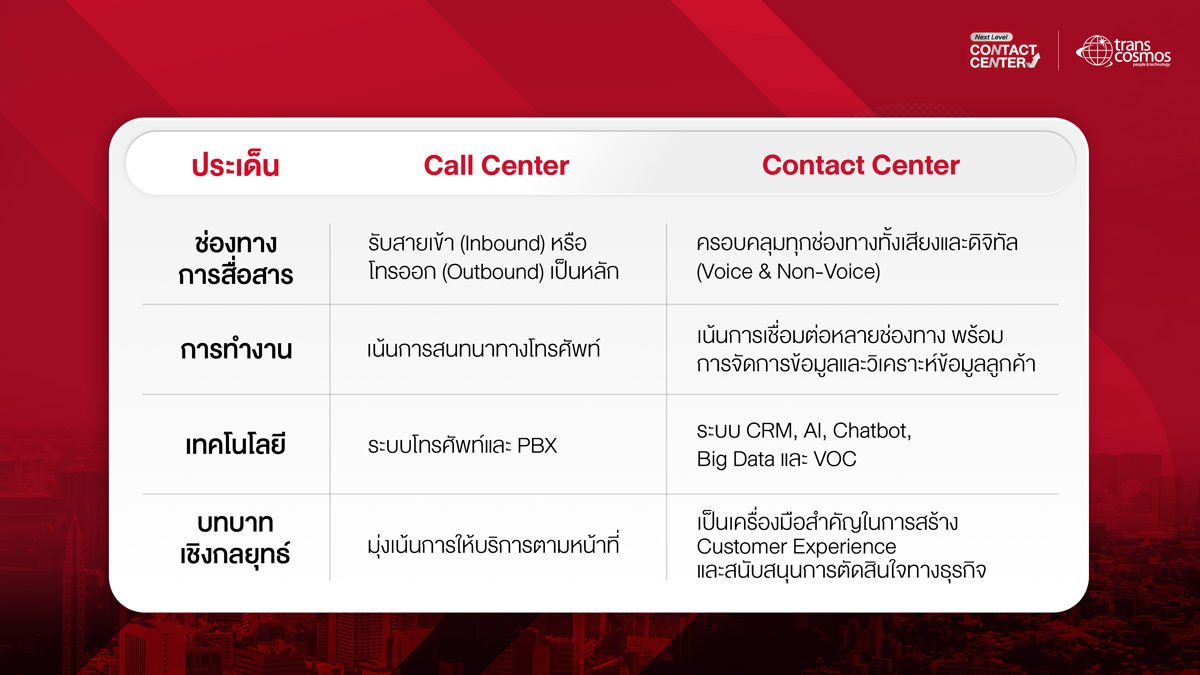
In summary, a Call Center only represents one component of a Contact Center, with a primary focus on telephone-based services. In contrast, a Contact Center covers all communication channels—both voice and digital—while leveraging advanced technologies to manage and analyze customer data. As a result, it plays a strategic role in enhancing customer experience and supporting comprehensive business growth.
2.The Importance of Contact Centers for Businesses
A Contact Center is no longer just a hub for handling calls or providing information. It has become a core element of customer relationship management in an increasingly competitive service-driven environment. Every customer interaction represents a valuable opportunity to create positive impressions and generate business value. When managed effectively, a Contact Center evolves into a strategic tool that supports sustainable business growth through the following key roles:
Delivering Superior Customer Experience (CX) Through Contact Center Services
A positive customer experience is a key factor that differentiates a brand from its competitors. As a result, the Contact Center serves as the frontline for creating strong first impressions—whether through consultation, issue resolution, or after-sales support. Having a professional, responsive team with a deep understanding of customer needs helps customers feel genuinely cared for, directly influencing customer satisfaction and brand loyalty.
In addition, Contact Center systems supported by continuous Quality Assurance (QA) processes help maintain consistent communication standards across all channels, enabling brands to deliver the same high-quality experience regardless of how customers choose to engage.
Connecting with Omnichannel and Communication Channels Across Both Voice and Non-Voice Channels
Consumer behavior in the digital era has changed significantly. Customers no longer interact with businesses through a single channel, but across multiple touchpoints—including phone, email, chat, websites, applications, and social media. As a result, having a Contact Center that fully supports omnichannel communication has become essential for modern businesses.
Modern Contact Center systems can unify all communication channels within a single platform, enabling agents to track customer interaction histories in real time. Whether a customer starts a conversation via chat and later switches to a phone call, information is seamlessly transferred without disruption. This results in a smooth and seamless customer experience, reduces repetitive communication, and improves efficiency for service teams while increasing overall customer satisfaction.
Collecting and Analyzing Customer Data for the Strategic Development
Contact Centers serve as a highly valuable source of business data, as every customer conversation and interaction is an insight that combines customer behavior, expectations, and brand satisfaction.
By integrating technologies such as CRM (Customer Relationship Management), AI (Artificial Intelligence) and Big Data Analytics, data collected from Contact Centers can be analyzed in depth to develop more accurate and actionable strategies, including:
- Enhancing services to better align with customer needs
- Predicting potential issues or customer complaints
- Delivering relevant upsell and cross-sell opportunities
- Planning targeted and personalized marketing campaigns
These insights enable businesses to make data-driven decisions and improve customer management effectiveness over the long term.
3.Technologies That Elevate Contact Center Performance
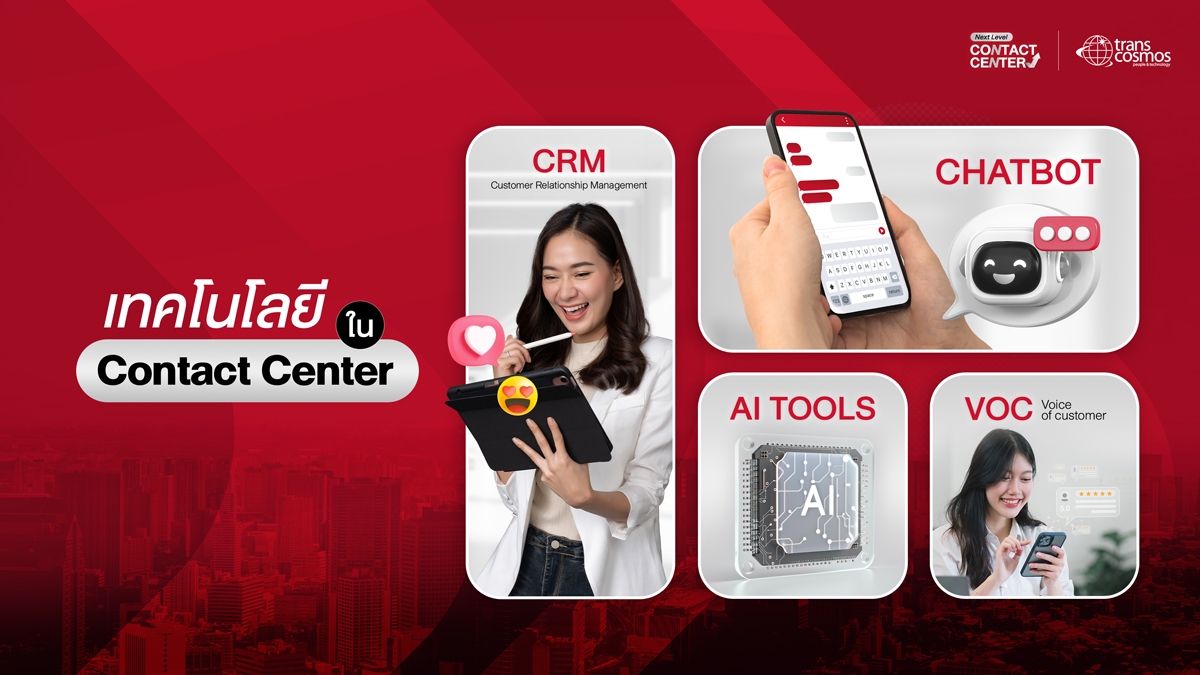
In the digital era, Contact Centers are no longer limited to handling phone calls. They have evolved into interaction hubs that integrate multiple systems, technologies, and data analytics to deliver better customer experiences, reduce operational costs, and create new business opportunities.Key technologies that currently play a critical role in driving modern Contact Centers include:
CRM System (Customer Relationship Management)
CRM systems collect customer data from all touchpoints, including phone calls, email, chat, website and application usage, as well as offline interactions. When integrated with Contact Center platforms, this data is unified in real time, allowing agents to instantly access complete customer profiles as soon as an interaction begins. This includes contact history, purchase records, previous complaints, and customer profile information—enabling agents to respond accurately without requiring customers to repeat information. Chatbots can also retrieve customer profiles from CRM systems to provide initial assistance.
From an analytics perspective, CRM systems segment customers based on behavior and purchase value to identify trends and customers with high upsell potential. These insights are visualized through dashboards, enabling management teams to clearly monitor key performance indicators such as average response time and first contact resolution rates.
As a result, effective CRM utilization enables more personalized customer service, reduces data redundancy and errors caused by fragmented systems, increases upsell opportunities, and supports executive decision-making with accurate data.
AI and Chatbot
Chatbots capture text and voice conversations using NLP and NLU to understand user intent, extract key information, and continuously improve response accuracy. This enables continuous improvement of responses and a deeper understanding of user needs. They also collect interaction data—such as response time, conversation length, and agent handoff points—which also captured for analysis, supporting ongoing service optimization and future performance improvements.
With AI-powered chatbots, customers receive instant responses without long wait times and benefit from 24/7 service availability without requiring human agents at all times. This reduces repetitive workloads and allows agents to focus on more complex tasks. Chatbots also assist agents by suggesting responses during live conversations, reducing information search time and improving accuracy. They further support ticket routing and automatically approve tickets for inquiries that require human intervention.
Common use cases include enabling customers to book services or purchase tickets directly via chat, acting as a virtual assistant for service inquiries, and automatically summarizing conversations after case completion. When integrated with CRM systems, chatbots can instantly access customer profiles, enabling more accurate and personalized responses while reducing resolution time and enhancing overall customer experience.
Data Analysis and Big Data Analytics
Data from all channels—such as phone calls, chat, email, and social media—is consolidated into a single centralized platform for efficient analysis. This includes both voice data converted into text and direct text-based interactions. Once collected, the data is structured and processed to identify frequently discussed topics, customer sentiment, recurring issues, and emerging trends.
These insights enable Contact Centers to detect issues earlier and address them before they impact a wider customer base. This helps reduce service time, increase first-contact resolution rates, and lower overall operational costs. Executives can also rely on real data for confident decision-making and use actionable insights to offer products and services that better match customer needs.
For example, speech analytics can identify frequently asked questions to highlight key customer concerns, while sentiment analysis can trigger real-time alerts when conversations show signs of risk. Real-time dashboards allow managers to monitor current conditions—such as rising call abandonment rates—and intervene promptly. Historical data can also be used to predict potential customer churn and support proactive retention planning.
VOC (Voice of Customer)
VOC captures customer feedback from multiple channels, including post-service surveys, in-depth interviews, conversation monitoring, and the analysis of comments, reviews, and social media content. These data points are analyzed to identify feedback trends over time and to uncover relationships between customer feedback and key business metrics, supported by reports that summarize critical insights.
With a structured VOC program, businesses can understand true customer perspectives, quickly identify improvement areas, reduce dissatisfaction risks, and reinforce customer confidence that their voices matter. Moreover, VOC also supports The new design of services and products, user experience improvements, and the evaluation of improvement plan whether it delivers measurable results.
A practical example of VOC implementation includes combining post-service satisfaction surveys with social media feedback analysis to identify frequently mentioned issues, such as service delays or incomplete information. Recorded conversations are further analyzed to uncover root causes, while VOC insights are shared across service, product, and marketing teams to drive improvements across all dimensions.
4. Inbound Call Solution
In today’s business landscape, customers have more choices and easier access to information than ever before. As a result, competition is no longer defined by price alone, but by who delivers better customer care. Creating positive service experiences has therefore become essential, and one solution that addresses this need is the Inbound Solution—professional handling of incoming customer interactions across all channels.
An Inbound Solution is a system or service designed to respond to incoming customer interactions across multiple channels, including phone, email, and social media. Its primary objectives are to provide accurate information, resolve customer issues efficiently, and deliver seamless after-sales support to ensure the best possible customer experience.
Overall, Inbound Solutions act as a frontline safeguard for businesses that interact directly with customers. When managed effectively, they build customer trust and enhance the overall customer experience. However, when poorly managed, they can become a critical weakness—causing customers to lose confidence and turn to competitors instead.
Types of Inbound Solutions
Inbound Solutions play a critical role as the first point of contact between customers and businesses—whether for information inquiries, issue reporting, or support requests. Delivering a positive service experience from the very beginning helps build strong impressions and customer trust, laying the foundation for long-term customer relationships. Within Contact Center operations, Inbound Solutions can be categorized into these following:
1. Providing product and service information
Customers require clear and comprehensive information before making purchasing decisions, including product details, features, pricing, and usage processes. Providing accurate, reliable, and timely information plays a critical role in building customer confidence, reflecting professional service standards, and strengthening overall brand credibility.
2. After-Sales Customer Support
Building strong customer relationships does not end after a purchase. It must be reinforced through effective after-sales support, including return or exchange management, usage assistance, and additional guidance to ensure the best possible customer experience. This ongoing support not only increases customer satisfaction, but also builds trust, strengthens brand loyalty, and encourages future service engagement.
3. Issue Resolution and Customer Consultation
When customers encounter issues or have questions, they expect fast and effective resolution. Providing accurate consultation and appropriate solutions can transform negative experiences into opportunities to create positive impressions, strengthen trust, and deliver sustainable brand value.
4. Feedback and Complaint Management
Customer feedback and complaints are valuable inputs for business improvement. Handling complaints transparently, promptly, and effectively not only resolves issues, but also demonstrates a strong commitment to continuous service improvement. These insights can be leveraged to enhance products, services, and operational processes for greater efficiency.
Benefits and Importance for Businesses
- Many businesses view Inbound Solutions as merely a service cost. In reality, they represent a strategic investment that delivers substantial business value, including:
- Increasing customer satisfaction and fostering long-term customer loyalty
- Reducing communication errors while enabling faster response times
- Delivering a seamless and memorable customer experience (CX)
- Collecting actionable insights to support data-driven marketing strategies
- Strengthening brand professionalism and overall credibility
Inbound Solution Use Cases
To provide a clearer perspective, the following examples illustrate how Inbound Solutions are applied across various industries.
E-commerce
A customer is considering purchasing a product online but is unsure whether it suits their needs. They contact the service center for clarification. When agents provide detailed product information, answer questions thoroughly, and proactively follow up on delayed deliveries, the customer gains confidence and is more likely to make repeat purchases.
Banking and Financial Institutions
A customer contacts the bank to inquire about their account balance and expresses interest in a new financial product, such as a loan. By clearly explaining the application process and offering relevant financial advice, agents not only ensure customer satisfaction but also encourage the customer to adopt additional financial services.
Telecommunications Providers
An internet user experiences a service disruption and contacts the customer support center. The team promptly diagnoses the issue, provides immediate troubleshooting guidance, and dispatches on-site technicians when necessary. Beyond resolving the issue quickly, agents may recommend a more suitable service package, delivering both service satisfaction and greater long-term value for the customer.
5. Outbound Solutions: What Can They Do?
Outbound Solutions enable businesses to proactively reach out to customers or prospects, rather than waiting for inbound contact. These systems support structured outbound campaigns with capabilities such as simultaneous dialing, intelligent call routing to available agents, on-screen customer data presentation before conversations, and call outcome tracking (e.g., connected, not reached, interested). The collected data is then used to continuously optimize future campaigns.
Types of Outbound Solution
In today’s highly competitive market, where customers have numerous choices, proactive engagement through Outbound Solutions—such as telemarketing, email outreach, and automated channels like SMS and chatbots—allows brands to reach customers faster and more directly. Beyond driving sales, these efforts help build awareness, stimulate interest, and continuously expand the customer base.
In addition, Outbound Solutions play a critical role in lead generation by identifying and engaging high-potential prospects and moving them into the sales pipeline. This approach enables businesses not only to retain existing customers, but also to drive long-term growth. Outbound Solutions can be applied in both B2C and B2B contexts, depending on business objectives and target audiences.
Outbound Solutions can be categorized based on their primary use cases as follows:
B2C (Business to Consumer): Outbound calls to end customers are used to promote offers, introduce new products, or communicate special privileges. This approach helps increase repeat purchases and enhance overall customer satisfaction.
B2B (Business to Business): Outbound engagement with companies or corporate clients focuses on creating new business opportunities, introducing strategic solutions, and offering services aligned with specific business objectives.
Telemarketing
Telemarketing remains a highly effective outbound strategy, even in today’s digital-first environment. Its key strength lies in direct, one-on-one conversations that allow brands to demonstrate genuine care and deliver a personalized customer experience. Telemarketing teams also act as brand representatives, conveying brand values and professionalism through every interaction.
Telemarketing activities typically include the following:
- Recommending products and services tailored to customer needs
- Providing up-to-date promotions and special offers
- Gathering in-depth customer feedback and insights
- Setting sales appointments to enable follow-up by the sales team
Lead Generation
Another core component of Outbound Solutions is lead generation—the process of building a pipeline of potential customers who show genuine interest in products or services. Lead generation goes beyond random outbound calls by applying targeted and data-driven strategies to identify, qualify, and continuously feed high-quality leads into the sales pipeline.
Common tools used for lead generation include:
- Cold Calling: Reaching out to new target audiences who are not yet familiar with the brand
- Email Marketing: Delivering targeted offers and valuable insights to generate interest
- Survey & Questionnaire: Collecting behavioral data and customer needs to support deeper analysis
The true value of lead generation lies not in the volume of contacts, but in securing qualified leads that are ready to enter the sales process. This helps teams save time and resources while significantly increasing the likelihood of successful deal closure.
Benefits and Outcomes of Outbound Solutions
Outbound Solutions deliver more than short-term sales results. They form a strong foundation for sustainable business growth by enabling proactive customer engagement.
Key benefits of Outbound Solutions include:
- Driving immediate sales through direct customer outreach
- Building a pipeline of new customers with qualified lead screening
- Enhancing brand awareness through proactive communication
- Accessing actionable insights to support data-driven marketing strategies
- Elevating customer experience and fostering positive customer relationships
When Outbound Solutions are well-designed and systematically executed, businesses can achieve tangible results—ranging from increased sales and higher conversion rates to valuable customer databases that deliver long-term value. Key outcomes include:
- Higher conversion rates through precise audience targeting
- Sustained revenue growth
- A high-quality lead database that can be leveraged over time
- A modern, proactive brand image that demonstrates customer-centricity
Overall, Outbound Solutions go beyond revenue generation by strengthening brand positioning and enabling businesses to compete and grow sustainably in an ever-evolving market.

6. Why Businesses Choose Contact Center Outsourcing
Contact Center Outsourcing allows businesses to focus on core activities—such as product development, marketing, and market expansion—without the time and resource burden of managing in-house customer service teams. It also reduces infrastructure investment costs, including office facilities, equipment, and software systems, while minimizing recruitment, training, and workforce management efforts—resulting in greater operational efficiency and cost savings.
Cost Optimization and Operational Efficiency in Team Management
Outsourcing helps lower operational expenses related to contact center operations, including staffing, training, equipment maintenance, and technology costs. By reducing management complexity, businesses can allocate more resources to their core priorities.
Increased Flexibility and Scalable Customer Support
Contact Center Outsourcing enables businesses to scale service capacity based on demand—expanding teams during peak periods and optimizing resources during lower volumes. In addition, 24/7 customer support improves customer satisfaction and strengthens long-term relationships.
Enhancing Quality and Efficiency Through Expert Support
Contact Center Outsourcing providers typically offer experienced and highly skilled teams capable of delivering high-quality customer service with efficient response handling. They also leverage advanced technologies and tools—such as CRM systems, data analytics, and automation—to manage customer interactions more effectively, improve operational efficiency, and reduce potential errors.
In today’s highly competitive environment, where customers are central to business success, maintaining a professional and standardized contact center is essential. Instead of investing significant time, budget, and resources in building in-house teams, many organizations choose Contact Center Outsourcing as a reliable and scalable solution.
7. Guidelines to Select a Contact Center Provider
In today’s highly competitive environment, where customers are at the core of every business, a standardized contact center plays a critical role in delivering positive customer experiences and maintaining strong customer relationships. However, building and managing an in-house contact center often requires significant time, budget, and resources. As a result, many organizations choose Contact Center Outsourcing as a practical and scalable solution.
Key Factors to Consider When Selecting a Contact Center Provider
Choosing a Contact Center Outsourcing partner is a strategic decision that directly impacts brand image and operational performance. A contact center is not merely a customer service channel—it serves as a critical connection between businesses and customers. Selecting the right partner therefore requires careful consideration of the following factors.
1. Service Standard
The provider should have a clearly defined Quality Management System, supported by continuous performance monitoring and evaluation. This includes Quality Assurance (QA) processes, call and chat monitoring, and employee performance evaluations. International certifications such as ISO, COPC, or PCI DSS further demonstrate professionalism, data security, and enterprise-level reliability.
2. Omnichannel Technology and Integrated Solutions
As customers communicate across multiple channels—such as phone, chat, email, and social media—providers should offer an Omnichannel Platform that seamlessly integrates all touchpoints into a single interface. A robust system enables agents to view complete interaction histories in real time, analyze communication trends, and deliver consistent responses across all channels.
3. Team Expertise
People are the core of any contact center. Agents should be trained in both soft skills—such as communication, active listening, and problem-solving—as well as in-depth product knowledge. A skilled team creates strong first impressions, which serve as the foundation for long-term customer loyalty.
4. Flexibility and Scalability
Business demands fluctuate over time, especially during campaigns or peak seasons. A reliable provider must be able to scale teams, system capacity, and operating hours quickly without compromising service quality. Scalability also includes the ability to support additional languages, expand cross-regional teams, and introduce new service channels in the future.
5. Past Performance and Experience
Evaluating case studies, reference clients, and customer testimonials helps businesses assess a provider’s service quality, management efficiency, and industry experience. Providers with a proven track record and long-term clients are generally more reliable and trustworthy.
Guidelines for Getting Started with Contact Center Outsourcing
Getting started with Contact Center Outsourcing requires a structured planning approach to ensure maximum operational efficiency and alignment with organizational needs.
1. Identify Business Pain Points
Begin by assessing current challenges—such as long customer wait times, increasing missed calls, or inconsistent service quality—to clearly define areas that require improvement.
2. Define Clear KPIs and Objectives
Establish measurable performance indicators, including Service Level, Customer Satisfaction (CSAT), First Call Resolution (FCR), and conversion rates, to evaluate provider performance effectively.
3. Start with a Pilot Project
Launching a pilot phase allows businesses to assess the provider’s ability to meet real operational requirements and refine processes before scaling to full deployment.
Long-Term Benefits of Contact Center Outsourcing
Partnering with Contact Center experts enables organizations to enhance agility while allocating resources more effectively toward core business growth. Beyond operational support, Contact Center Outsourcing delivers long-term strategic value across multiple dimensions. Key long-term benefits include:
1. Reduced Operational Costs
Businesses can avoid heavy investments in systems, infrastructure, and additional staffing, leading to long-term cost efficiency and better budget optimization.
2.Improved Service Performance Through Professional Teams
Experienced service teams enhance speed, accuracy, and service consistency while leveraging modern technologies to maximize operational efficiency.
3.Enhanced Customer Experience (CX)
Fast, relevant, and responsive service across all touchpoints creates positive brand impressions, driving long-term customer satisfaction and loyalty.
4.Stronger Focus on Core Business
By outsourcing customer service operations, organizations can fully concentrate on product development, marketing strategies, and market expansion.
5. Flexible Support for Scalable Business Growth
Contact Center providers with scalable systems and ready-to-deploy teams enable organizations to grow seamlessly. This flexibility supports rapid expansion across customer volumes, interaction demand, and service scope—without operational disruption.
 8. Why Choose transcosmos for Contact Center Services
Strengths and Differentiation from Other Providers
transcosmos is a global Contact Center provider with over 50 years of experience supporting leading enterprises across multiple industries, including automotive, financial services, retail, technology, and e-commerce. By combining advanced technology with a human-centric service approach, transcosmos delivers superior customer experiences while effectively addressing diverse business needs.
Leveraging CRM, AI, Chatbot, Big Data and VOC Technologies
transcosmos integrates digital technologies as a core part of its Contact Center operations, including:
- CRM (Customer Relationship Management): Enables end-to-end customer data management, ensuring accurate, consistent, and seamless service delivery.
- AI & Chatbot: Accelerates response times, reduces repetitive workloads for agents, and delivers real-time conversational experiences.
- Big Data Analytics: Analyzes large volumes of customer data to identify trends, customer needs, and service improvement opportunities.
- VOC (Voice of Customer): Collects customer feedback across all channels to support continuous service quality improvement.
By integrating these technologies, transcosmos operates a flexible and scalable Contact Center—capable of adjusting service capacity based on customer demand and responding effectively to evolving business needs.
Industry Expertise and Case Studies
With extensive international experience, transcosmos possesses deep industry-specific knowledge that enables the design of tailored solutions aligned with each sector’s unique requirements. For example, within Japan’s automotive industry, transcosmos has delivered Contact Center services for a leading global automotive manufacturer—successfully maintaining the highest Customer Satisfaction Index in the country for multiple consecutive years. This achievement demonstrates transcosmos’ ability to manage customer experience in a structured, scalable, and sustainable manner.
Commitment to Quality Excellence and Talent Development
transcosmos places strong emphasis on continuous service quality control and human development through specialized training programs designed by industry experts. These programs enhance product knowledge while strengthening communication and problem-solving capabilities. In addition, transcosmos leverages quality technologies such as Speech Analytics to evaluate service performance in real time and continuously refine service standards.
9.Summary: Contact Centers and the Future of Business in the Digital Era
Building Sustainable Customer Experience
In a market where customers have abundant choices, fast, accessible, and personalized service is essential to building sustainable customer relationships. Developing a flexible Contact Center that can respond to customer needs in real time creates positive experiences that foster long-term loyalty and brand trust.
Leveraging Technology to Drive Customer Service
Technologies such as AI, chatbots, big data, and automation tools are becoming key drivers of Contact Center efficiency. They enable accurate, fast, and effective handling of inquiries, issue resolution, and customer communication. By combining technology with deep customer insights, businesses can anticipate needs in advance and deliver high-quality proactive services.
A Strategic Option for Businesses Seeking Scalable Growth
Selecting an experienced Contact Center partner such as transcosmos represents a strategic investment that strengthens an organization’s competitive capabilities. With comprehensive expertise across technology, skilled professionals, and global experience, transcosmos enables organizations to:
- Enhance customer experience (CX improvement)
- Increase operational efficiency
- Optimize management and operational costs
- Support sustainable growth in the digital era
In today’s fast-changing business landscape, Contact Centers are no longer limited to customer support functions. They have evolved into a central hub of customer experience and business value—empowering organizations to gain deeper customer understanding and achieve long-term, sustainable growth.
“Customer satisfaction” is one of the most important indicators of business success.
If your organization is looking to develop a Contact Center that delivers both advanced technology and superior customer experience, transcosmos is ready to be your trusted partner—providing end-to-end solutions from customer service systems to sustainable operational performance enhancement.